
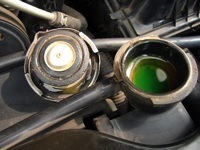
Once you have finally succumbed to the necessity to replace the coolant in your car, you now face a more daunting reality.
The general types of coolant used today by do it yourselfers fall into one of 3 main categories:
- Inorganic Acid Technology (IAT),
- Organic Acid Technology (OAT), and
- Hybrid Organic Technology (HOAT)
The Ethylene Glycol type of Inorganic Acid Technology (IAT) anti-freeze that became available in 1930's and remained the standard for many years began to be "muscled out" by Dex-Cool coolant (an OAT type of coolant) in GM products in the 90's. This new type of coolant used a totally different formulation than the old "green stuff", which was then followed by Ford and Chrysler using a hybrid organic acid technology based coolant as well (HOAT). Not to mention the Japanese and European cars going in their own respective, but similar directions.
All of these different formulations are built upon either Ethylene Glycol or Polypropylene Glycol bases as a rule. While the Ethylene Glycol is toxic to animals and can be harmful to paint, Polypropylene Glycol is less toxic to animals and paint, and is increasing in its popularity after it was first introduced in France following public pressure.
As was mentioned earlier, the usual green or Ethylene Glycol Inorganic based coolant was the standard for American cars until the mid-1990's. The IAT type of anti-freeze had a typical service cycle of 2 years or 30,000 miles and contained silicates and phosphate corrosion inhibitors that protected cast-iron engines, bimetal (cast/aluminum) engines, and copper/brass radiators.
Once GM began to introduce the OAT type of coolant with its Dex-Cool, the IAT types of coolants began to be phased out in favor or OAT types of coolants, which remove the silicates and phosphates in favor of organic acids. Why the change? Manufacturers moved away from copper/brass radiators to aluminum radiators for weight at about the same time, and the OAT type of coolants have a typical service life of 5 years or 150,000 miles. The results for our British cars seems to be that the OAT type of coolant, while good with cast iron and aluminum, is not protective of the copper/brass radiators and heater cores that we have, and may be harmful to our gaskets and water pumps as well.
Hybrid Organic Acid Technology, or HOAT's, began to appear here in the States during the period of 2001-2003 in Chrysler, Ford, Mercedes, BMW, Volvo, and Mini Cooper cars. These types of coolants have a typical service live of 5 years or 150,000 miles as well, and are similar in general characteristics to OAT type anti-freeze.

Confused yet?
As a result of retailers not wanting to carry a dozen varieties of coolant based on individual manufacturers needs, coolant suppliers have developed universal coolants formulated on OAT based products, which they say can be used safely in all makes and models. The jury is still out on this claim, and has been challenged by the Better Business Bureau at some levels.
What is the bottom line for older cars using copper/brass radiators such as our British cars? All of the articles and coolant manufacturers reviewed suggest following the manufacturer's requirements. Great. In looking at Bentley's Workshop book, it refers the home mechanic to use "anti-freeze solutions of the ethylene glycol type incorporating the correct type of corrosion inhibitor" while the 1980 owners manual further refers the home mechanic to use anti-freeze "which conforms S.A.E. J1034 or BS 3151/2 (Unipart Universal Antifreeze). Unfortunately, I can't remember the last time I saw a Unipart anti-freeze container.
My research has found at least one product that appears to be satisfactory for our cars. Zerex Original Formula Anti-Freeze looks like an excellent candidate. It is IAT based and actually refers to the SAE J1034 standard mentioned in the 1980 MGB owner's manual. You can review the product technical bulletin online on Valvoline's website (download the product information PDF for the details). It is available full strength or 50/50 premix in one gallon containers for the do it yourselfer.
Conclusion
In summary, based on the articles and websites reviewed, use IAT formulated "green" anti-freeze if you can find it for your British car.
Second best would be the universal variety of anti-freeze, remembering to change your fluids more frequently than the 5 year or 150,000 mile cycle.





Want to leave a comment or ask the owner a question?
Sign in or register a new account — it's free